• (+86)21 80399582-801
  • Emergency Industrial Park,Wenzhou, Zhejiang , CN
  • tech.sales@leadingtec.cn

Tag: Microalgae

CO2 fixation capability of Chlorella sp. and its use in treating agricultural wastewater

chlorella sp.

Palm oil mill effluent (POME) is a highly polluted agro-industrial wastewater. The CO2 in industrial flue gas requires treatment before it can be discharged into the environment. Utilizing microalgae as the agent to treat wastewater and industrial flue gas is a waste-to-wealth approach. The resulting biomass can be commercialized in the form of valuable products. Chlorella sp. is a microalgal species that can tolerate the pollutant load and has been proven to be a suitable species for CO2 fixation. In…

Growth factors in oceanic sediment significantly stimulate the biomass and lipid production of two oleaginous microalgae

Phaeodactylum tricornutum

This study demonstrates the effects of growth stimulators in oceanic sediment on biomass and lipid production of two oleaginous microalgae, Botryococcus braunii LB572 andPhaeodactylum tricornutum B2089. At the optimal mixing ratio of culture medium and oceanic sediment extract of 6:4 (v/v), specific growth rates of B. braunii LB572 and P. tricornutum B2089 increased 13.0- and 11.3-fold, respectively, compared to a sediment-free medium. The maximum biomass and lipid productions of B. braunii LB572 were 5.54 and 3.09 g L−1, and those of P.…

High temperature enhances lipid accumulation in nitrogen-deprived Scenedesmus obtusus XJ-15

GY-D13 Scendesmus obliquus

This study investigated the changes in lipid and starch contents, lipid fraction, and lipid profile in the nitrogen-starved Scenedesmus obtusus XJ-15 at different temperatures (17, 25, and 33 °C). The optimal temperature for both growth and lipid accumulation under nitrogen-sufficient condition was found to be 25 °C. However, under nitrogen deprivation, the total and neutral lipids increased with increasing temperature, and achieved the highest lipid content of 47.60 % of dry cell weight and the highest TAG content of 79.66 % of total lipid…

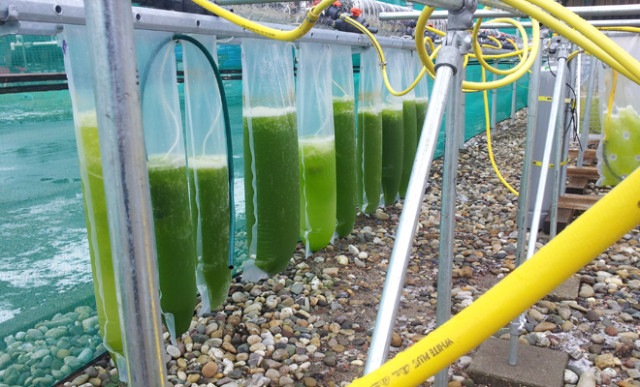
Outdoor production of Tisochrysis lutea in pilot-scale tubular photobioreactors

Photobioreactor

In this paper we study the outdoor production of Tisochrysis lutea in pilot-scale tubular photobioreactors (3.0 m3). Experiments were performed modifying the dilution rate and evaluating biomass productivity and quality, in addition to the overall performance of the system. Results confirm that T. lutea can be produced outdoors on a commercial scale in continuous mode, obtaining productivities of up to 20 g m−2 day−1 of biomass, which are rich in proteins (45 % d.wt.) and lipids (25 % d.wt.). The utilization of this type of photobioreactor allows one…

Algae used as roofing material

algae used as roofing material

An experiment to test the use of algae in bitumen production has proved successful in multiple ways. The tests, recently completed in Groningen (NL), show that algae can be grown in the waste-stream of a bitumen factory, which consumes CO2. The test went further, demonstrating that these algae can then be used in the production of bitumen for roofing and other purposes. The algae are grown using the gases from oil heaters. Warmed by these machines, they consume the CO2…

Effect of biodegradable chelating ligands on Fe uptake in and growth of marine microalgae

Chattonella marina

Iron (Fe) is an important nutrient for phytoplankton. The low solubility of Fe in oxic waters can be a growth-limiting factor for phytoplankton. Synthetic aminopolycarboxylates (APCs) such as ethylenediaminetetraacetic acid (EDTA) and diethylenetriaminepentaacetic acid (DTPA) are widely used as Fe complexing agents for microalgae culture. However, the presence of these non-ready biodegradable APCSin aquatic systems may have serious environmental consequences. In the present study, the effects of biodegradable chelating ligands (hydroxyiminodisuccinic acid (HIDS), methylglycinediacetic acid (MGDA), and iminodisuccinate (IDS)) on…

An efficient method for the sequential production of lipid and carotenoids from the Chlorella Growth Factor-extracted biomass of Chlorella vulgaris

chlorella sp.

Efficient methodology for simultaneous extraction of multiple bioactive compounds from microalgae still remains a major challenge. The present study provides a method for the sequential production of three major products: Chlorella Growth Factor (CGF, a nucleotide-peptide complex enriched with vitamins, minerals, and carbohydrates), lipid, and carotenoids from Chlorella vulgaris biomass in an economically feasible manner. After protein-rich CGF was extracted, the spent biomass was found to contain 12% lipid and 3% carotenoids when extracted individually, compared to that of the…

Use of microalgae to recycle nutrients in aqueous phase derived from hydrothermal liquefaction process

Microalgae By Hydrothermal Liquefaction

Hydrothermal liquefaction (HTL) of microalgae biomass generates an aqueous phase (AP) byproduct with limited energy value. Recycling the AP solution as a source of nutrients for microalgae cultivation provides an opportunity for a cost-effective production of HTL based biofuel and algal biomass feedstock for HTL, allowing a closed-loop biofuel production in microalgae HTL biofuel system. This paper aims to provide a comprehensive overview of characteristics of AP and its nutrients recycling for algae production. Inhibitory effects resulted from the toxic…

Microalgae Aquatic (Animal) Vaccines Coming Soon

In recent years, the aquatic industry has suffered from the frequent occurrence of aquatic animal diseases, which has caused huge economic losses to aquaculture enterprises and farmers each year. Aquatic animal vaccines have the characteristics of immune disease, safety, high efficiency, and no pollution (compared with antibiotics) and undoubtedly it’s the first choice for control of aquatic animal diseases. British MicroSynbiotiX company is developing a fish oral vaccine. The researchers introduced the synthetic DNA encoding the vaccine into the microalgae…

Archaeologist reveals: Spirulina is the true ancestor of mankind

Archaeology, as an industry that traces its origins to the ancient times, its practitioners must not only possess a profound historical foundation, but also must master the most advanced science and technology, because many historical mysteries can only be solved by applying modern technologies, such as the radioactive isotope C14 being archeological. Known as the “carbon bell,” it is prone to beta decay and becomes a new nucleus. Its half-life is 5730, and it can therefore be used to determine…