
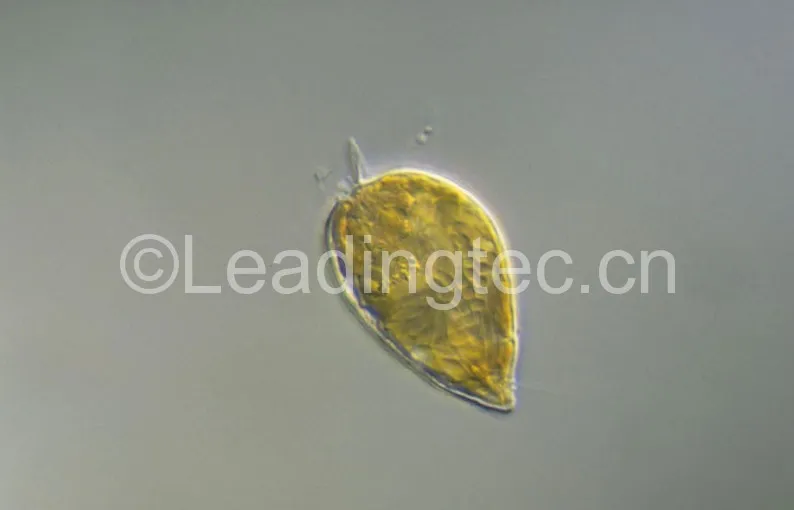
Shanghai Guangyu Biological Technology Co., Ltd. supplies Prorocentrum minimum (GY-H38 Prorocentrum minimum also known as the mini-Prorocentrum) algae strains, culture media and related cultivation technology, as well as 1 L–5000 L photobioreactor culture equipment with temperature display, pH display, light intensity display, heating, water pump, air pump, auto-dimming LED light source and other algae culture accessories. You are welcome to contact us.
Culture medium:F/2


Prorocentrum minimum is one of the main bloom-forming organisms of temperate and subtropical waters worldwide, and is very common in the Bohai Sea, East China Sea and South China Sea. In 1977 a bloom of this species in coastal waters off Dagu, Tianjin, covered 570 km² and caused massive fish and shrimp mortality; in 2000 a more serious bloom in the Zhoushan Islands affected as much as 7,000 km².
Prorocentrum minimum – Morphology
In valve view the cell is cordate or ovate, 15–23 μm long and 13–17 μm wide, with an apical spine about 1 μm long. The apical spine is short, forked and apical; the secondary spines are short. Both thecal plates are covered with small projecting spines, and trichocyst pores are sparsely distributed on the plate surface.
Prorocentrum minimum – Distribution
An inshore, cosmopolitan species, occurring along the Chinese coast and in inner bays.
Prorocentrum minimum – Identification
The cell shape is variable; in valve view it is cordate or ovate. Length is 15–23 μm, width 13–17 μm, and the apical spine is about 1 μm long. The cell is widest near the anterior end, which is truncate; the posterior end tapers and is rounded. The apical spine is short, forked and apical; the secondary spines are short. Two flagella arise from a slightly thickened, V-shaped region around the flagellar pore at the centre of the anterior end. Both thecal plates are covered with small projecting spines, and trichocyst pores are sparsely distributed on the plate surface. The nucleus is circular or spherical and posterior; there are two plate-shaped, yellowish-brown chromatophores.
Prorocentrum minimum – Hazards
Prorocentrum minimum can produce diarrhetic shellfish poisons and cause human poisoning, posing a serious threat to fisheries and human health.
Prorocentrum minimum – Significance
Accurate, rapid detection of Prorocentrum minimum population dynamics in the marine environment, and timely knowledge of changes in its abundance, are of great importance. Traditionally the alga is observed and counted directly under a light microscope — a time-consuming process that requires an experienced taxonomist and is difficult to apply to large numbers of samples in real time. Developing new methods and technologies for detecting P. minimum is therefore important for studying the early development of blooms caused by this species. To date, however, qualitative and quantitative detection techniques for this alga have not yet achieved ideal results.
Product Forms
- Strain on solid medium in test tubes (can be shipped by express courier)
- Liquid strain culture (100 ml – 5 L packages)
- Large-volume algae culture (over 5 L, shipped by freight)


Reviews
There are no reviews yet.