
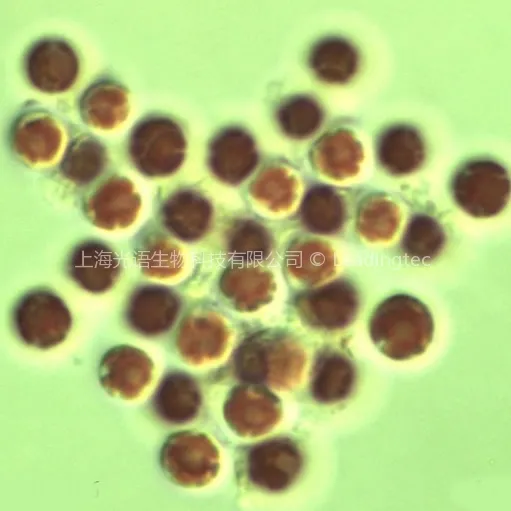
Shanghai Guangyu Biological Technology Co., Ltd. supplies Porphyridium cruentum (GY-H56) algae strains, culture media and related cultivation technology, as well as 1 L–5000 L photobioreactor culture equipment with temperature display, pH display, light intensity display, heating, water pump, air pump, auto-dimming LED light source and other algae culture accessories. You are welcome to contact us.
Culture medium:F/2
Guangyu Biotech also suppliesculture-media nutrients for large-scale microalgae cultivation.
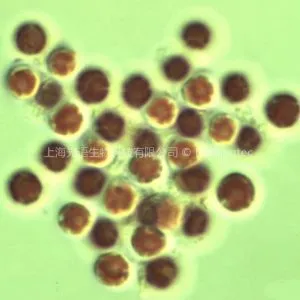
GY-H56 Porphyridium cruentum Porphyridium cruentum
Classification
Kingdom Protista
Phylum: Rhodophyta
Subphylum: Rhodophytina
Class: unicellular algae (Porphyridiophyceae)
Order: Porphyridiales
Family: Porphyridiaceae
Genus: Porphyridium
Culture Methods
The organism is unicellular, circular or ovate; the chromatophore is stellate, with a naked pyrenoid. It grows on damp ground or in corners of walls.
Environmental conditions: inorganic salts are the main factor affecting Porphyridium growth. Organic substances such as urea can promote growth; vitamins have little effect. Glucose, sucrose and lactose also promote growth and can increase the yield of bioactive substances.
Temperature and pH: the suitable temperature for Porphyridium growth is 13–31 °C, with an optimum of 21–26 °C. Low temperature has an important effect on the intermediate metabolism of long-chain unsaturated fatty-acid synthesis, indicating that low-temperature stress can promote long-chain fatty-acid synthesis but reduces biomass.
Light: Porphyridium barely grows in darkness and has no special requirement for a light–dark cycle; continuous light favours growth. Changes in light intensity and quality affect growth and alter the amounts and ratios of metabolites and photosynthetic pigments. Studies show that increasing light from 538 lx to 4,300 lx increases the growth rate by 400%, indicating that, within a certain range, higher light promotes growth. Weak light promotes phycoerythrin synthesis and strong light promotes polysaccharide synthesis; the stronger the external light, the greater the amount of polysaccharide secreted.
Salinity: Porphyridium has a wide salinity range; 30–46‰ has no significant effect on its growth.
Culture should follow the actual conditions.
The development and wide application of modern biotechnology have deepened research on the culture and development of Porphyridium. New techniques such as photobioreactor culture and strain improvement by genetic and cell engineering will accelerate industrialization. High-density culture and harvest technology are currently the main constraints on development. We intend to achieve large-scale fermentative culture by a heterotrophic route, lowering costs, raising yield and quality, and opening a new path to industrial production.
Product Forms
- Strain on solid medium in test tubes (can be shipped by express courier)
- Liquid strain culture (100 ml – 5 L packages)
- Large-volume algae culture (over 5 L, shipped by freight)


Reviews
There are no reviews yet.