

Shanghai Guangyu Biological Technology Co., Ltd. supplies Oedocladium sp. (GY-D22) algae strains, culture media and related cultivation technology, as well as 1 L–5000 L photobioreactor culture equipment with temperature display, pH display, light intensity display, heating, water pump, air pump, auto-dimming LED light source and other algae culture accessories. You are welcome to contact us.
Culture medium:BG11
Classification
|__Kingdom: Plantae
|__Phylum: Chlorophyta (green algae)
|__Order: Oedogoniales
|__Family Oedogoniaceae
|__Genus Oedogonium
Research Applications
Oedogoniales
Oedogoniales — an order of the Chlorophyta. The thallus is filamentous, unbranched or branched, attached to a substrate by a basal cell or rhizoidal branches, or floating on the water surface. Cells are uninucleate; the chromatophore is parietal and reticulate, with one to many pyrenoids. Vegetative cell division is distinctive, and sexual differentiation is relatively complex.
This order comprises 1 family, 3 genera and about 600 species, all freshwater. In China it is most abundant in the Yangtze and Pearl River basins, especially in the central and southwestern provinces, and also occurs at 5,000 m in the Himalayan region of Tibet. Vegetative cell division involves a ring formed on the inner side of the upper lateral wall; after a circular split opens on the outside, this ring extends and thickens to become the side wall of the daughter cell, while the retained portion of the old wall at the apex forms a “cap”, and another retained portion forms a “ring” or sheath. After this process has been repeated several times, a vegetative cell may have a stack of several caps at its upper end. In addition, the zoospores, androspores and spermatozoids of this order all have a ring of numerous flagella at the anterior end of the cell.
Asexual reproduction produces, within the mother cell, a zoospore with a ring of flagella at the anterior end. Sexual reproduction is oogamous, but several types occur (see figure): (1) Monoecious — antheridia and oosporangia are borne on the same plant; each antheridium produces two motile spermatozoids with a ring of equal flagella at the anterior end, and each oosporangium contains a single large, non-motile egg. (2) Dioecious with a large male plant — antheridia and oosporangia are borne on separate plants and produce spermatozoids and eggs respectively. (3) Dioecious with dwarf males, and androspores on the same plant as the eggs — the same plant bears both androsporangia and oosporangia, producing androspores and eggs; the androspore resembles a zoospore but is smaller, attaches to a female plant after release, and forms a dwarf male that produces antheridia and spermatozoids. (4) Dioecious with dwarf males, and androspores on a separate plant — androsporangia and oosporangia are on different plants; after release the androspore forms a dwarf male on the female plant, producing antheridia and spermatozoids. After fertilization the egg becomes an oospore, which undergoes meiosis to yield four zoospores, each developing into a new plant. In dioecious species with large males, the four zoospores from one oospore develop into equal numbers of female and male plants.
The Oedogoniales comprise only one family, the Oedogoniaceae, with three genera. Oedogonium and Bulbochaete are aquatic; Oedocladium is aerophytic and has not yet been recorded in China.
The Oedogoniales were once placed in a separate class, the Oedogoniophyceae, because of their distinctive swimming cells with a ring of flagella at the anterior end, but most phycologists regard them as only an order, since the same flagellar arrangement is also found in Derbesia of the Siphonales.
Oedogonium is the largest genus in the family.
Product Forms
- Strain on solid medium in test tubes (can be shipped by express courier)
- Liquid strain culture (100 ml – 5 L packages)
- Large-volume algae culture (over 5 L, shipped by freight)
Product Prices
Other Algae Strain List
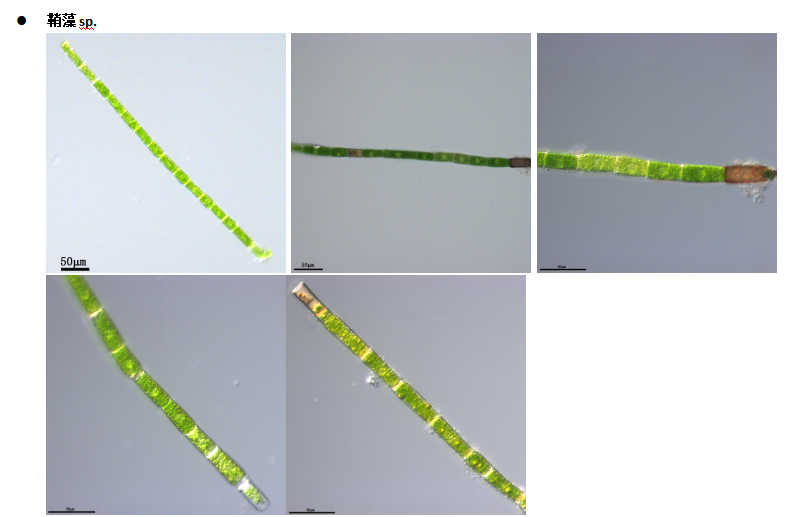
Oedocladium



Reviews
There are no reviews yet.