
Shanghai Guangyu Biological Technology Co., Ltd. supplies Karenia mikimotoi (GY-H36) algae strains, culture media and related cultivation technology, as well as 1 L–5000 L photobioreactor culture equipment with temperature display, pH display, light intensity display, heating, water pump, air pump, auto-dimming LED light source and other algae culture accessories. You are welcome to contact us.
Culture medium:F/2


Classification
Kingdom Protista
Dinophyta (dinoflagellates)
Dinophyceae
Gymnodiniales
Gymnodiniaceae
Karenia
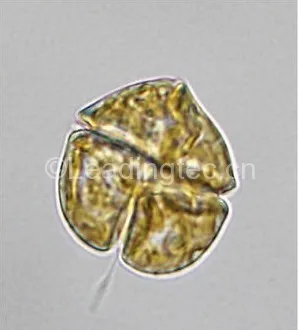
Karenia mikimotoi belongs to the Gymnodiniales, genus Karenia. The organism is unicellular and motile. Cells are 15.6–31.2 μm long and 13.2–24 μm wide.
In dorsoventral view the cell is nearly circular but slightly flattened; it rocks from side to side when swimming, and at rest only the dorsoventral face is usually seen under the light microscope, the side or apical/antapical views being hard to observe. The epitheca is hemispherical or broadly conical; the centre of the hypothecal antapex has a distinct depression, and the right antapex is slightly longer than the left.
The cingulum starts slightly above the cell mid-point, makes one left-handed turn and ends at or slightly below the mid-point. The displacement between the two ends is 0.725–1.055 of the cell length, averaging 0.92.
5. The sulcus begins at the origin of the cingulum and extends to the antapex. At the start of the cingulum, traces of the sulcus invading the epitheca can be seen. The apical groove begins slightly above and to the right of the cingulum origin and runs over the apex or its left side to the dorsal side of the cell. The nucleus is ovoid and in the lower left of the cell. There are 10–16 chromatophores (n = 20) [4].
Karenia mikimotoi is a toxic bloom-forming alga. In June 2004 a bloom of about 1 km² occurred near the Dongtou Islands, with a maximum density of 2.4 × 10^7 cells/L; follow-up monitoring found no fish mortality, possibly because the bloom was short-lived and small in area. In May 2003, K. mikimotoi was detected in a Prorocentrum dentatum bloom in the Nanji Islands.
Product Forms
- Strain on solid medium in test tubes (can be shipped by express courier)
- Liquid strain culture (100 ml – 5 L packages)
- Large-volume algae culture (over 5 L, shipped by freight)


Reviews
There are no reviews yet.