
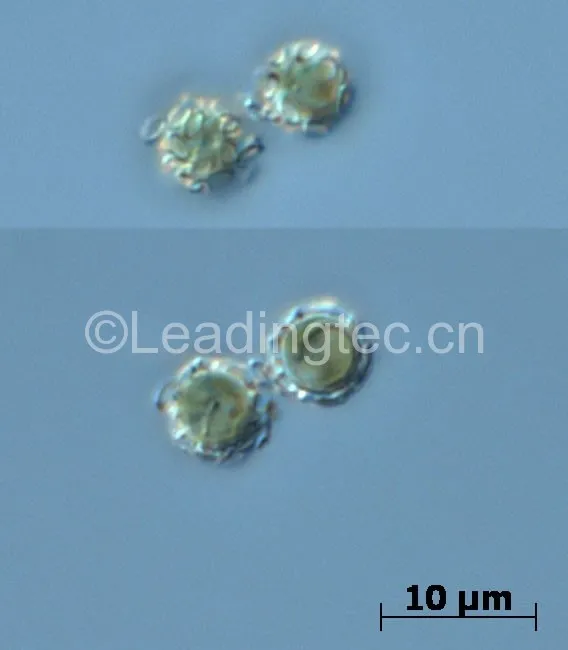
Shanghai Guangyu Biological Technology Co., Ltd. supplies coccolithophore (Emiliania huxleyi) (GY-H45 Emiliania huxleyi(Lohm.)Hay et Mohler, also known as Emiliania (marine coccolithophore)) algae strains, culture media and related cultivation technology, as well as 1 L–5000 L photobioreactor culture equipment with temperature display, pH display, light intensity display, heating, water pump, air pump, auto-dimming LED light source and other algae culture accessories. You are welcome to contact us.
Culture medium:F/2


Classification
| Domain: | Eukaryota |
| Kingdom: | Chromalveolata |
| Phylum: | Haptophyta |
| Class: | Prymnesiophyceae |
| Order: | Isochrysidales |
| Family: | Noelaerhabdaceae |
| Genus: | Emiliania |
| Species: | E. huxleyi |
Basic Information
Cells are spherical, ovoid, or elongated and pear- or spindle-shaped. At the anterior end are two equal or nearly equal flagella and a whip-like haptonema (adhesive or tactile filament). Each coccolithophore cell contains one nucleus and a pair of yellowish-brown chromatophores. Outside the cell membrane is a mucilaginous layer; on its inner side lie non-mineral scales about 1 μm in diameter, and in or on the mucilage are minute rounded bodies — the coccoliths. Some coccolithophores have a flagellated motile stage and a non-flagellated non-motile stage in the life cycle. In the motile stage they swim in surface waters; in the non-motile stage coastal species rest on the bottom while oceanic species drift passively in the water column. Coccoliths are generally formed in the non-motile stage; the motile stage may lack coccoliths or bear a different type. Most coccolithophores are autotrophs, photosynthesizing with sunlight and dissolved carbon dioxide, nitrate and other inorganic salts. Some coastal species can use organic nitrogen. A few ingest bacteria and small algae and are heterotrophic. Growth in water is relatively rapid, typically about one division per day. The number of coccoliths per cell varies among genera and species; together they form a nearly spherical to ovoid “exoskeleton” called a coccosphere. After death the coccosphere disintegrates into many coccoliths, which may be preserved as fossils. Coccoliths are very small, generally about 1–15 μm in diameter. They are abundant and tiny, and are a major component of calcareous ooze on the ocean floor.
In 1858, Huxley found in Atlantic deep-sea ooze the crystalline objects Ehrenberg had called “morpholites”, regarded them as inorganic, and named them “coccoliths”, a name still used today.
In 1861, Wallich and Sorby found that these coccoliths formed a sphere, which they called a coccosphere (Coccosphaera). Sorby found that the coccoliths had distinctive optical properties and regarded them as independent organic structures.
The first to apply coccoliths as palaeontological fossils were G. Deflandre and E. Kamptner in Europe, who proposed nannopalaeontology (Nanno-Paleontology). The use of calcareous nannofossils as biostratigraphic markers followed the widespread expansion of deep-sea geological surveys and the application of the electron microscope.
In 1954, M. Bramlette and W. Riedel of the United States gave a comprehensive account of the stratigraphic significance of discoasters and coccoliths, proposing that discoasters could be used for worldwide correlation of pelagic sediments, and thereby enabling biostratigraphic zonation with calcareous nannofossils.
Culture Conditions
Coccolithophores are photosynthetic, autotrophic phytoplankton and are almost all marine. Their adaptation to the following conditions is outlined below:
1. Salinity
The great majority of coccolithophores live in seawater of normal salinity, mainly in open-sea and oceanic settings. Only about nine species can live in freshwater, in genera such as Hymenomonas, Pontosphaera, Acanthoica and Anacanthoica. Salinity tolerance differs among species. Cricosphaera elongata can live in low-salinity water of 0.4–25‰, whereas some taxa tolerate high salinity; in the laboratory, Emiliania tolerates 16–45‰. In some genera the salinity range changes through the life cycle. In Cricosphaera, non-motile individuals have been reported to tolerate salinities as high as 236‰, whereas motile stages range from 4–18‰ to 45–150‰, with a maximum tolerance of only about 90‰. Diversity falls sharply in waters of abnormal salinity: the modern Mediterranean has about 75 living coccolithophore species, but the freshened Black Sea has only 23. Calcareous nannofossils usually occur in normal marine sediments; only unusual forms are occasionally found in transitional marine–terrestrial strata, so they are generally taken as indicators of a marine environment. No confirmed calcareous nannofossils have yet been reported from continental deposits.
2. Temperature
Under normal marine conditions, temperature is the main control on the horizontal distribution of coccolithophores. In general they are warm-water organisms, and most species occur in waters of 18–23 °C. The temperature ranges of Discosphaera tubifera (18–27 °C), Rhabdosphaera stylifera (15–28 °C) and Helicosphaera carteri (15–25 °C and above) are typical of warm-water species. A few species live in distinctly warmer or colder waters and may be called warm-water or cold-water species. A cold-water example is Coccolithus pelagicus, which lives at 7–14 °C and prefers 8–9 °C. A warm-water example is Umbellosphaera irregularis, which tolerates 21–30 °C and grows best at 25–30 °C. Some species are eurythermal: Emiliania huxleyi occurs from 2–29 °C and Calcidiscus leptoporus from 8–26 °C. In these eurythermal species, morphological features also vary with water temperature. In the warm-water form of E. huxleyi the central area is open and both shields are made up of 30–40 elements, whereas in the cold-water form the central area is closed or has a central structure, the proximal shield is tightly united, and the distal shield has only 23–33 elements; transitional types occur between the cold- and warm-water forms. In the modern ocean, coccolithophore assemblages change with latitude and can be divided into latitudinal assemblage zones. From the distribution of coccolithophores in the Pacific, Okada and Honjo (1973) recognized six zones from north to south: the subpolar, transitional, north-central, north-equatorial, south-equatorial and south-central zones. These correspond in practice to four belts: equatorial, central, transitional and subpolar. The dominant taxa of these four assemblages are, respectively, E. huxleyi (polar type); E. huxleyi (cold-water type) and Rhabdosphaera clavigera; Umbellosphaera irregularis; and Gephyrocapsa oceanica together with E. huxleyi (warm-water type), G. oceanica and U. irregularis. Similar latitudinal belts can be recognized worldwide and compared among the major oceans. Diversity is high in tropical and subtropical assemblages and falls sharply towards the poles: the equatorial Pacific and Atlantic have about 10 species, whereas the subpolar Pacific has only one and the subarctic Atlantic only three. Temperature preferences have also been studied in extinct coccolith groups such as discoasters, which are warm-water plankton most abundant in tropical marine sediments, although a few species tolerate a wide temperature range. The characteristic calcareous nannofossil assemblages of different temperature belts are an important basis for palaeoecological and palaeoceanographic research.
3. Depth
Coccolithophores depend on sunlight for photosynthesis, so their vertical distribution is controlled by light. Studies of living species show that they occur mainly at depths of 10–200 m, and are most abundant from a few metres below the surface to 10–20 m in temperate seas or to 50 m in tropical seas. Most species have a limited depth range. In general, smaller, lighter genera and species occur nearer the surface, and larger, heavier ones deeper. Some species, such as Oolithotus fragilis, can live at a range of depths. In the Pacific, for example, coccolithophores in the subpolar zone are concentrated from the surface to 30 m, decline clearly at 30–50 m, and disappear below 100 m. In the transitional zone they are concentrated at 50–100 m, at higher abundance than at the surface. In the equatorial zone they are concentrated around 50 m depth.
4. Nutrients and other factors
Besides temperature, other factors such as upwelling explain why coccolithophores flourish in the warm-temperate and tropical zones. Within 40°N and 40°S, some areas are zones where seafloor upwelling and ocean currents meet, the richest in nutrients and highest in organic production; the inorganic nutrients brought by upwelling and currents support the growth of coccolithophores and other phytoplankton.
Product Forms
- Strain on solid medium in test tubes (can be shipped by express courier)
- Liquid strain culture (100 ml – 5 L packages)
- Large-volume algae culture (over 5 L, shipped by freight)



Reviews
There are no reviews yet.