



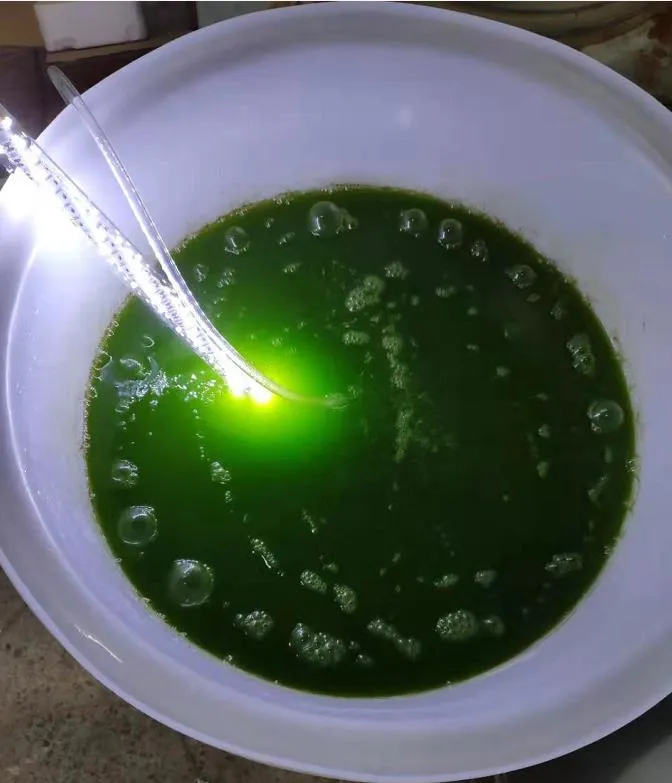
Chlorella (Chlorellasp)

Guangyu Biotech provides aquaculture customers with a Chlorella scale-up package for water conditioning, including a highly active Chlorella strain and medium.
Note: for Chlorella, higher activity matters more than higher density. We will supply inoculum until the customer’s scale-up succeeds.
culture medium
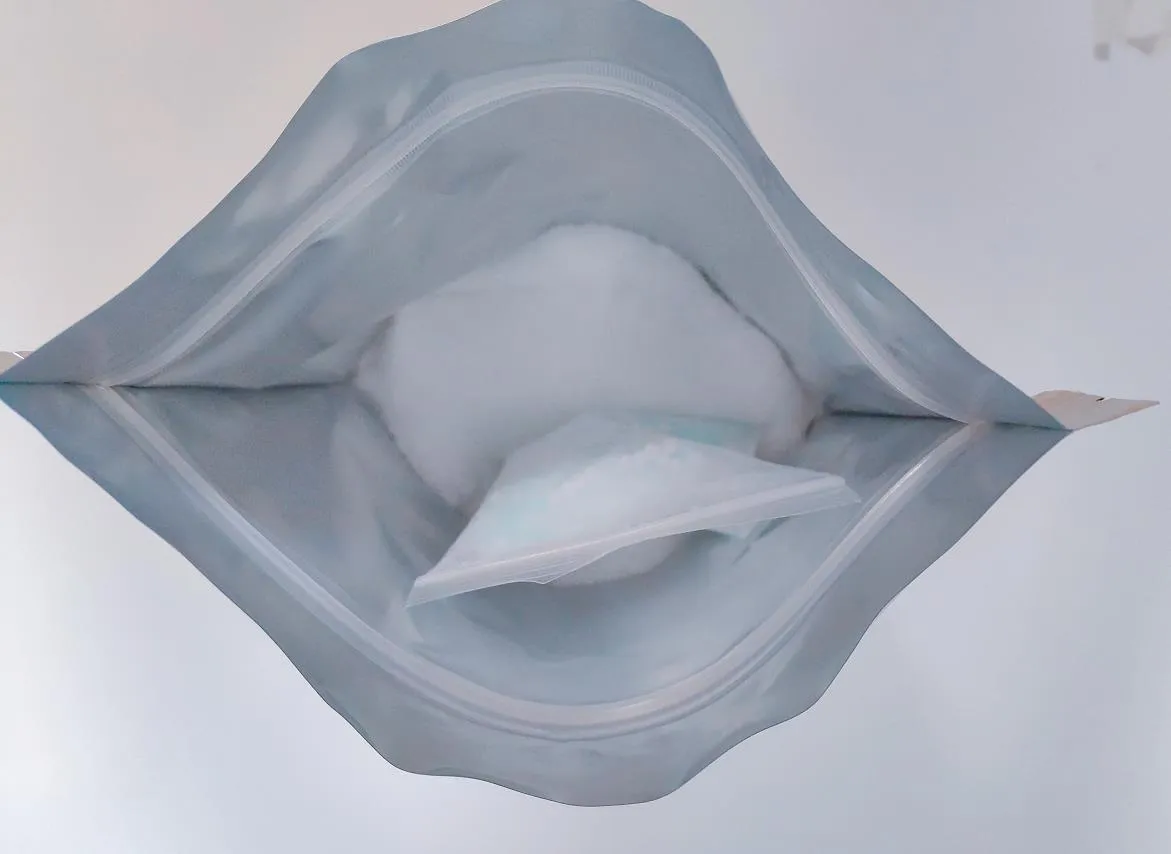
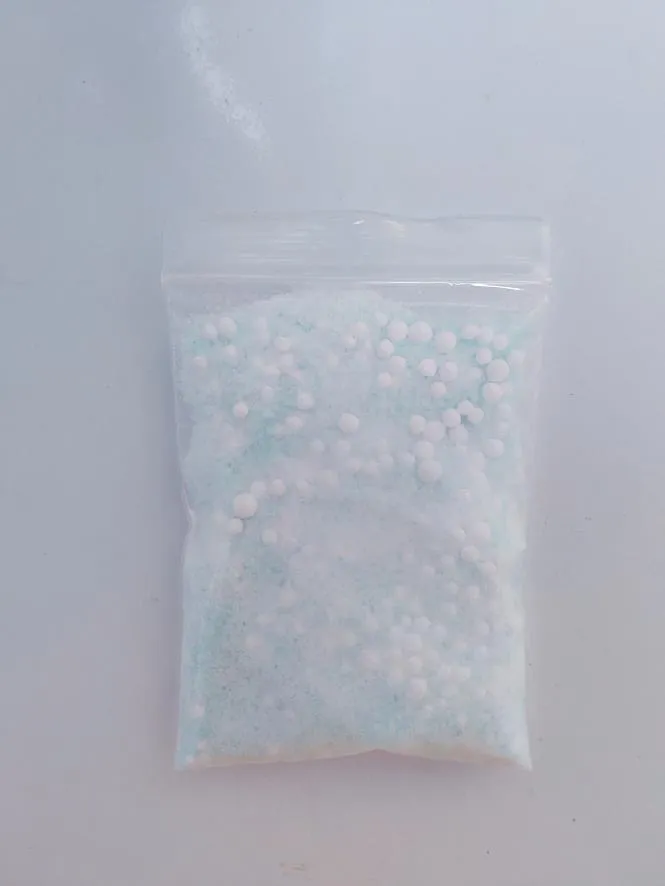
We supply Chlorella medium, about 640 g per pack, sufficient to scale up 1 tonne of Chlorella.


Chlorella culture medium
Chlorella algae strains
Guangyu Chlorella strains are supplied as primary and secondary inocula.
The primary strain is 300 yuan, supplied as 100 ml of primary inoculum.
Secondary seed is 500 yuan per 8 kg, excluding tax and freight.


2tChlorellaPackage:Chlorellastrain +Chlorellaculture medium =600 yuan
Basic composition:
1. Chlorella: 8 kg of secondary Chlorella inoculum is supplied.
2. Chlorella medium: two packs of Chlorella medium are supplied, sufficient to scale up 2 tonnes of Chlorella.
Culture steps:
Primary culture: used mainly for strain maintenance, principally in conical flasks, which can be fully sterilized and are therefore especially used for stock culture, generally in an air-conditioned indoor room. The steps for primary seed culture are as follows:
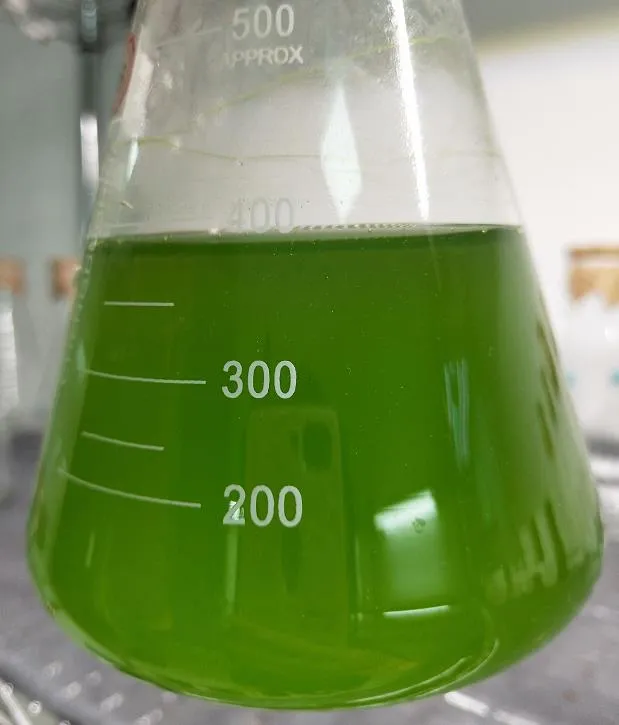
1. Take 250 ml of sterilized medium and 250 ml of culture in exponential phase, and inoculate at 1:1. After mixing, culture in a 500 ml conical flask at 2,000 lx and 25 °C, with 24-hour continuous light.
2. After 5–7 days the density has clearly increased and the culture can be scaled up. Divide the 500 ml culture into two equal parts, inoculate at medium:culture = 4:1, and continue culture in two 1 L conical flasks.
3. After 5–7 days continue scale-up, inoculating at medium:culture = 4:1, and continue culture in two 5 L conical flasks.
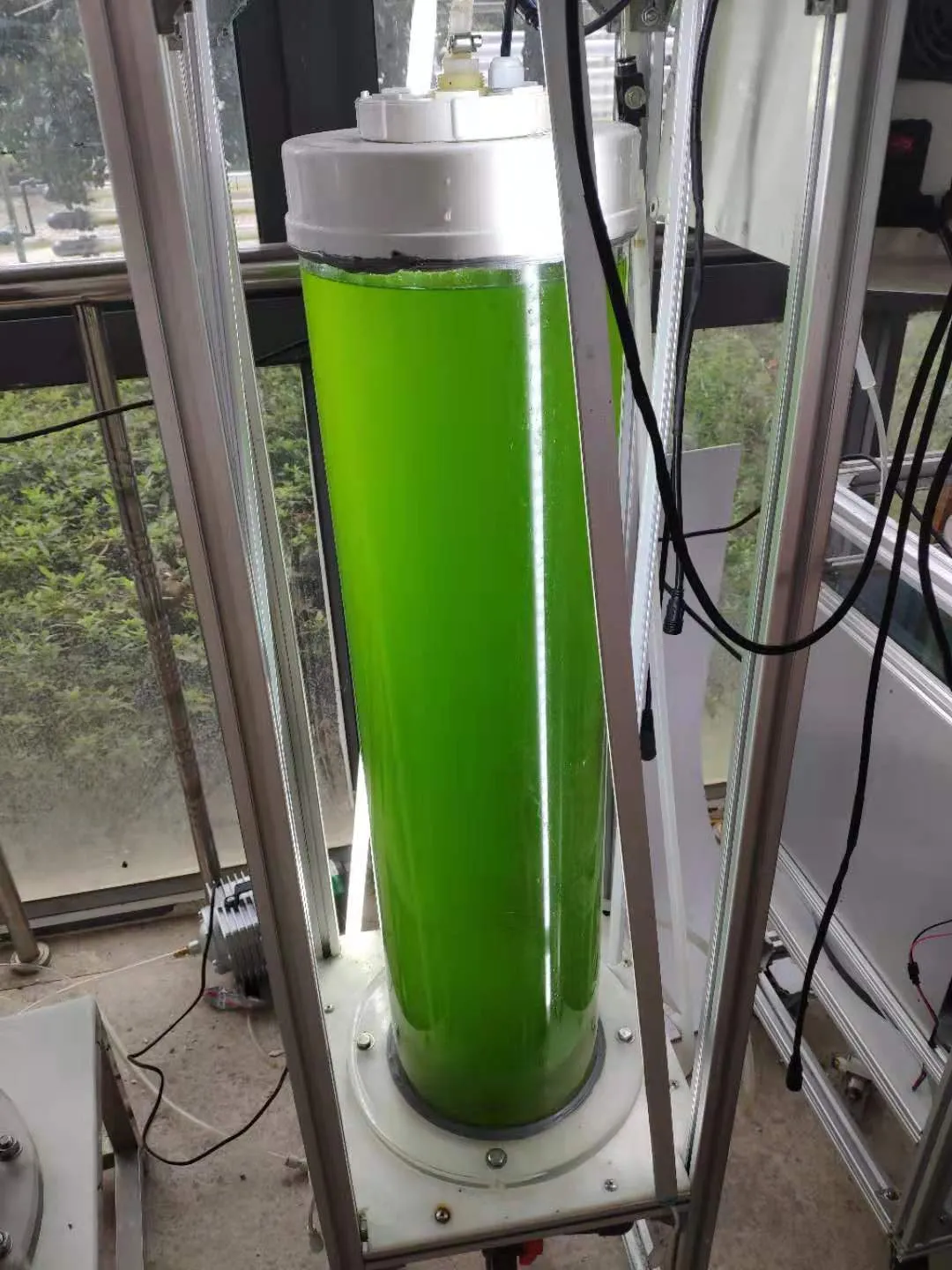
Secondary culture: mainly in white plastic drums (polypropylene) of 50–500 L, indoors or outdoors. Guangyu columnar photobioreactors may also be purchased, providing lighting, aeration, temperature control and other systems. Secondary seed culture is an expansion of the primary seed, inoculated at medium:algal culture = 10:1, in a white plastic drum (with supplementary light and aeration) or a 100 L columnar photobioreactor, at 3,000 lx, 25 °C, with 24-hour lighting and 24-hour aeration.
Tertiary culture: mainly in small indoor concrete tanks of about 10, 20 or 30 m³, well lit, with white translucent fibreglass sheeting or plastic film on the workshop roof for seed culture. Large Guangyu equipment (for example a tubular photobioreactor) may also be purchased for scale-up. Tertiary expansion is inoculated from secondary seed at medium:algal culture = 10:1 or 20:1, generally under natural light.
Use of the medium:
1. Dissolve one bag of medium (640 g) in 2 kg of boiled, cooled tap water to make a 500-fold concentrate. Dilute proportionally with tap water for use: for 100 kg of tap water add 0.2 kg of concentrate; for 200 kg add 0.4 kg; and so on.
2. Take 8 L of secondary Chlorella culture, add it to 100 kg of medium and mix well;
3. Place the mixed culture in a white plastic drum or a photobioreactor at 25–28 °C, with the circulating pump and lighting running 24 h a day. After 5–7 days a dark-green Chlorella culture is obtained.


How can Chlorella be used in production to achieve the best results?
In aquaculture, Chlorella is used not only for water-quality treatment but also as the most natural first-feed for fish, shrimp and crabs. Before artificial culture, or in natural waters, Chlorella is the first-choice starter feed. It should therefore be cultured before the larval stage as a starter feed, and then also applied in water conditioning.
Chlorella is most suitable for water-quality management in the following situations. First, when the water is clear, oligotrophic, or turbid and lacks algal inoculum. Second, after a pond crash, when the water urgently needs to be stabilized and a good algal assemblage restored. At this stage the water is black and foul; adding Chlorella can quickly stabilize the environment and reduce stress on fish, shrimp and crabs, thereby lowering the incidence of disease, because Chlorella can multiply once added and process harmful substances in the water. Third, to compete with harmful algae and maintain the dominance of desirable species.
What environment and nutrients does Chlorella need? Will it die naturally if it remains in the water for a long time?
Chlorella grows well in water of 25–33 °C and, when nutrients are sufficient, can be established in ponds with a long-lasting, stable effect. It is not particularly demanding of water quality and prefers water relatively high in ammonia nitrogen and nitrite. The nutrients it needs are mainly carbon and nitrogen fertilizers, so a pond that meets certain carbon and nitrogen conditions can support it. For concrete tanks we also supply a dedicated Chlorella medium. Chlorella persists relatively long in natural waters; like other plants it produces resting stages (“seeds”). In theory, as long as nutrients are suitable and water quality and weather are not too poor, Chlorella can maintain an algal balance through continual self-renewal and persist indefinitely.


Reviews
There are no reviews yet.