• (+86)21 80399582-801
  • Emergency Industrial Park,Wenzhou, Zhejiang , CN
  • tech.sales@leadingtec.cn

News

Guangyu presents to you – “Blue Tears” Noctiluca scintillans

There is a beautiful mythological story about noctiluca scintillans. A long, long time ago, there lived a mysterious creature in the oceans on the earth, and they were called noctiluca scintillans. Noctiluca scintillans possessed magical powers and could emit a bright blue light at night, illuminating the entire ocean. It is said that the light of noctiluca scintillans is stimulated by the emotions in their hearts. When noctiluca scintillans feels happy and blissful, their light will become even brighter and…

The morphological world of microalgae: The diverse beauty. Guangyu Biology reveals it all for you.

In that mysterious and vast nature, microalgae are like glittering pearls, emitting unique charm. And their diverse shapes are becoming a remarkable source of inspiration in the field of design. The appearance of microalgae is full of endless variations. Some are in a round and lovely spherical shape, just like pearls carefully carved by nature, giving people a feeling of softness and purity. These rounded shapes can inspire designers to create simple and affinity-rich product shapes, such as rounded home…

Effects of nitrogen delivery on chitin nanofiber production during batch cultivation of the diatom Cyclotella sp. in a bubble column photobioreactor

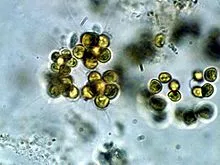
Cyclotella sp.

The photosynthetic diatom Cyclotella sp. extrudes chitin nanofibers following cell division. This diatom requires silicon for cell wall biosynthesis and division, as well as nitrogen for biosynthesis of intracellular material and extracellular chitin, an N-acetyl glucosamine biopolymer. The initial nitrogen/silicon molar ratio was the critical parameter for assessing the limits of nitrogen delivery on cell number and chitin production during batch cultivation ofCyclotella in a bubble column photobioreactor under silicon-limited growth conditions, using nitrate as the nitrogen source. The peak…

Does a large-scale continuous algal production system provide a stable supply of fatty acids to bivalve hatcheries?

Isochrysis galbana

The variation of fatty acid (FA) content and composition of the microalgal production (Isochrysis sp., Pavlova lutheri and Chaetoceros muelleri) in a continuous large-scale production system (500-L bags) used in hatcheries were analysed. The variation of the FAs was analysed in replicate bags over time for the different species. Total FA content (pg cell−1) increased significantly (p < 0.05) in the P. lutheri and C. muelleri bags over time. The content of the essential FAs (arachidonic acid (ARA), eicosapentaenoic acid (EPA), n-6…

Sorption of fluorescent polystyrene microplastic particles to edible seaweed Fucus vesiculosus

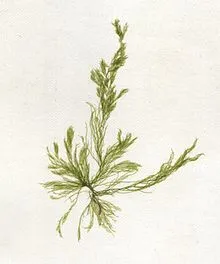
Fucus vesiculosus

Increased global demands for food have raised interest for seaweed as a healthy and sustainable food source. At the same time, the large amounts of microplastic in the oceans have raised concern in relation to pollution of seafood including sea vegetables. The aim of this study was to examine sorption of fluorescent polystyrene (PS) microplastic particles to edible macroalga (seaweed) Fucus vesiculosus, and to investigate to what extent adsorbed PS particles could be washed off, using an industrial relevant method.…

CO2 fixation capability of Chlorella sp. and its use in treating agricultural wastewater

chlorella sp.

Palm oil mill effluent (POME) is a highly polluted agro-industrial wastewater. The CO2 in industrial flue gas requires treatment before it can be discharged into the environment. Utilizing microalgae as the agent to treat wastewater and industrial flue gas is a waste-to-wealth approach. The resulting biomass can be commercialized in the form of valuable products. Chlorella sp. is a microalgal species that can tolerate the pollutant load and has been proven to be a suitable species for CO2 fixation. In…

Growth factors in oceanic sediment significantly stimulate the biomass and lipid production of two oleaginous microalgae

Phaeodactylum tricornutum

This study demonstrates the effects of growth stimulators in oceanic sediment on biomass and lipid production of two oleaginous microalgae, Botryococcus braunii LB572 andPhaeodactylum tricornutum B2089. At the optimal mixing ratio of culture medium and oceanic sediment extract of 6:4 (v/v), specific growth rates of B. braunii LB572 and P. tricornutum B2089 increased 13.0- and 11.3-fold, respectively, compared to a sediment-free medium. The maximum biomass and lipid productions of B. braunii LB572 were 5.54 and 3.09 g L−1, and those of P.…

Heterotrophic growth and oil production from Micractinium sp. ME05 using molasses

Micractinium pusillum

In this study the thermo-resistant green alga Micractinium sp. ME05 was cultivated in media containing molasses as a carbon source. Shake flask experiments and 2-L bioreactor experiments were conducted at different inoculum ratios, aeration rates, and agitation speeds. The experimental condition which resulted in the highest biomass concentration (3.73 ± 0.45 g L−1) with 10% inoculum in 500-mL flasks was scaled up to 2-L flasks at two aeration rates (0.25 and 0.5 L min−1). An increase in biomass concentration from 2.35 ± 0.53 to 3.06 ± 0.21 g L−1 was observed…

Use of Monascus sp. NP1 for bioethanol production from Cladophora glomerata

Cladophora

The fungus Monascus sp. was able to produce ethanol instead of red pigment under glucose derepression with greater and more tolerance to ethanol than yeast. Algae are known as a polysaccharide resource for bioethanol production. This work was focused on the optimization of cellulase production through solid-state fermentation of straw and rice bran usingTrichoderma viride TISTR 3161 for saccharification by the alga, Cladophora glomerata. The best conditions for alga enzymatic hydrolysis were proposed after varying crude enzyme and temperature, comparing…

Production performance, immune response and carcass traits of broiler chickens fed diet incorporated with Kappaphycus alvarezii

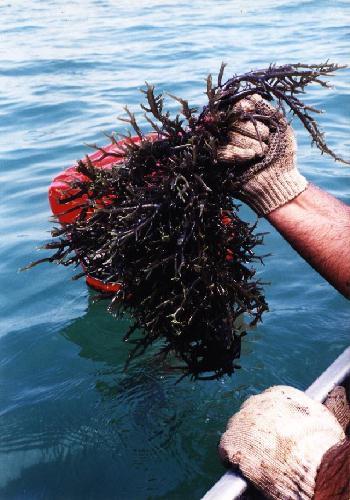
Kappaphycus alvarezii

This study evaluates the production performance, immune responses and carcass traits in broiler chickens (0 to 42 days) fed diet with incorporated Kappaphycus alvarezii (AF-KWP). Day-old chicks (280) were randomly distributed into 35 groups with 8 chicks in each group (7 dietary treatments × 5 replicates). Seven experimental diets were formulated by adding 0 (control—T1), 0.25 AF-KWP (T2), 0.50 AF-KWP (T3), 0.75 AF-KWP (T4), 1.00 AF-KWP (T5), 1.25 AF-KWP (T6) and 1.50 AF-KWP (T7) respectively. Body weight gain (g) significantly (P < 0.05)…