
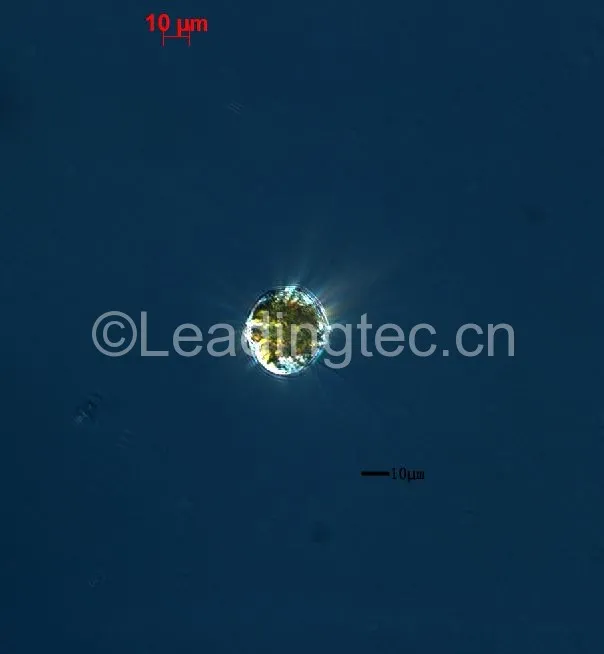
Shanghai Guangyu Biological Technology Co., Ltd. supplies Alexandrium sp. (GY-H52) (strongly fluorescent) algae strains and related cultivation technology, as well as 60 L–100 L photobioreactor culture equipment with temperature display, pH display, light intensity display, heating, water pump, air pump, auto-dimming LED light source. You are welcome to contact us.

Alexandrium strongly fluorescent (GY-H52 Alexandrium sp.)

Alexandrium strongly fluorescent (GY-H52 Alexandrium sp.)
The cell is spherical and relatively small, 15–29 μm in diameter, brownish-green, with a sheath. Cysts are spherical to slightly flattened, circular in apical view (diameter 25–35 μm) and ovate in side view (28–35 μm long, 20–30 μm wide). Most cells contain granular material and a small amount of orange-yellow substance. There is a narrow ventral pore.
Basic Characteristics
Alexandrium grows in tropical and temperate coastal and estuarine waters. It is the most widespread PSP-toxin species in the Mediterranean and one of the two main organisms responsible for PSP events in Southeast Asia (Vila et al., 2001; Lim et al., 2006). It is concentrated in harbours, estuaries and lagoons, associated with low salinity and nutrient-rich freshwater inputs. Culture experiments show that it is eurythermal and euryhaline (Grzebyk et al., 2003; Cannon, 1996). Growth rate increases with temperature and light (Lim et al., 2006). After a period of acclimation, relatively high growth rates can also be reached at 12 °C.
Ecological Impact (ECOSYSTEM)
Alexandrium is a small dinoflagellate that can form coastal algal blooms. It was first recorded during a red tide in Alexandria harbour. High concentrations of toxin produced by this unicellular alga are a major cause of paralytic shellfish poisoning (PSP) in people in many parts of the world. The toxins can also affect other organisms in the ecosystem, including mammals, birds, fish and zooplankton. Unlike the similar species Alexandrium tamarense, A. minutum produces only a relatively limited set of PSP toxins (GTX1–GTX4). Even small amounts are harmful to zooplankton and fish and can reduce copepod reproduction. The toxins accumulate in zooplankton, shellfish and crabs, and can cause paralytic poisoning in humans or other mammals that consume them. They are neurotoxins, causing muscle paralysis and neurological symptoms and, in severe cases, death (Hallegraeff, 1993; Van Dolah, 2000). During blooms, shellfish farms may be closed for fear of PSP outbreaks, with economic losses.
Description
Alexandrium minutum Halim, 1960
Species Overview:
Alexandrium minutum is an armoured, marine, planktonic dinoflagellate. It is a widely distributed species associated with toxic PSP blooms in coastal regions.
Taxonomical Description:
Cells of A. minutum are small, nearly spherical to ellipsoidal, somewhat dorsoventrally flattened and occassionally longer than wide (Figs. 1-4). Cells are single with a characteristic ventral pore on the first apical plate, 1′ (Figs. 2-4,8,9). Thecal plates thin. Thecal surface ornamenation can vary from light to heavy reticulation (mostly confined to the hypotheca) with small scattered pores. Intercalary bands are present (Figs. 1-3). Large range in size in this species: between 15-30 µm in length and 13-24 µm in transdiameter width (Balech, 1989, Balech, 1995, Hallegraeff, 1991, Taylor et al., 1995, Steidinger and Tangen, 1996, Hwang et al., 1999).
Thecal Plate Description:
The plate formula for A. minutum is: Po, 4′, 6”, 6c, 10s, 5”’, 2””. The epitheca is larger than the hypotheca. The apical pore complex (APC) is oval to broadly triangular and pointed posteriorly (Fig. 3). The apical pore plate (Po) is large, narrow and oval with a wide foramen (Figs. 3,9). The Po can be either in direct contact with the first apical plate (1′) (Figs. 3,9a) or indirectly connected via a thin suture (thread-like process) (Fig. 9b). This connection can be obscured by plate growth overlap by plates 2′ and 4′. A characteristic ventral pore is located on the slender and rhomboidal 1′ plate (Figs. 2-4, 8,9). The distinctive sixth precingular plate (6”) is long and narrow (Fig. 1) (Balech, 1989, Balech, 1995, Hallegraeff, 1991, Taylor et al., 1995, Steidinger and Tangen, 1996, Hwang et al., 1999).
The epitheca is hemielliptical to conical with convex sides (Figs. 1,2,4). The apex is broadly rounded. The short hypotheca is hemielliptical with a convex to flat antapex (Figs. 1,2,4). The deeply excavated cingulum is displaced in a descending fashion one time its width with thickened margins (Figs. 1,2,4). The sulcus is shallow with narrow lists (Figs. 1,2) (Balech, 1989, Balech, 1995, Hallegraeff, 1991, Taylor et al., 1995, Steidinger and Tangen, 1996, Hwang et al., 1999).
Morphology and Structure:
A. minutum is a photosynthetic species with an elliptical nucleus (Balech, 1989, Balech, 1995).
Reproduction:
A. minutum reproduces asexually by binary fission. This species also has a sexual cycle that produces a characteristic resting cyst (Figs. 6,7) (Bolch et al., 1991).
Ecology:
A. minutum is a planktonic dinoflagellate species associated with toxic PSP events in coastal regions around the world. This species also produces dense (reddish-brown) red tides (Hallegraeff, 1991). A red tide of this species reported from Taiwan had cell densities as high as 2.5 X 10^7 cells/L (Hwang et al., 1999). Another red tide of A. minutum reported from South Australia revealed cell levels of 4.8 X 10^8 cells/L (Cannon, 1990).
This species produces a clear resting cyst as part of its life cycle. Cysts vary from hemispherical to circular in shape: cyst circular in apical view (24-29 µm in diameter) (Fig. 6); kidney-shaped in lateral view (15-19 µm long) (Fig. 7). The cyst wall is covered with mucilage (Bolch et al., 1991).
Toxicity:
Alexandrium minutum is a strong producer of PSP gonyautoxins: GTX1, GTX2, GTX3 and GTX4 (Oshima et al., 1989). These toxins can affect humans, other mammals, birds and possibly fish (Hallegraeff et al., 1988, Hallegraeff, 1991). This species is responsible for PSP events in Taiwan (Hwang et al., 1999), South Australia (Hallegraeff et al., 1988, Cannon, 1990), France (Nezan et al., 1989) and New Zealand (Chang et al., 1995).
Habitat and Locality:
Alexandrium minutum is widely distributed species found in many coastal areas of the world. Populations have been recorded from Alexandria Harbor, Egypt (Halim, 1960), Italy (Montresor et al., 1990), northern Adriatic waters (Mediterranean Sea) (Honsell, 1993), Turkey (Koray and Buyukisik, 1988), Spain and Portugal (as A. ibericum) (Balech, 1985b), France (Nezan et al., 1989), South Australia (Hallegraeff et al., 1988), and the east coast of the United States (Steidinger and Tangen, 1996).
Classification
Kingdom Protoctista
Phylum Dinoflagellata
Subphylum Pyrrhophyta
Class Dinophyceae
Order Gonyaulacales
Family Goniodomaceae
Genus Alexandrium
Species Alexandrium minutum
Product Forms
- Strain on solid medium in test tubes (can be shipped by express courier)
- Liquid strain culture (100 ml – 5 L packages)
- Large-volume algae culture (over 5 L, shipped by freight)


Reviews
There are no reviews yet.