
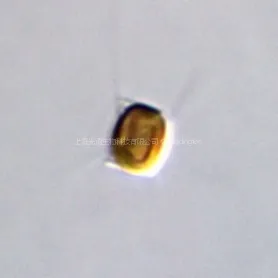
Shanghai Guangyu Biological Technology Co., Ltd. supplies Chaetoceros muelleri (GY-H10) algae strains, culture media and related cultivation technology, as well as 1 L–5000 L photobioreactor culture equipment with temperature display, pH display, light intensity display, heating, water pump, air pump, auto-dimming LED light source and other algae culture accessories. You are welcome to contact us.
Culture medium:F/2+Si
Guangyu Biotech also suppliesculture-media nutrients for large-scale microalgae cultivation.


Classification
Kingdom Chromista
Phylum Ochrophyta
Class Coscinodiscophyceae
Order Centrales
Family Chaetoceraceae Chaetocerotaceae
Genus Chaetoceros
Chaetoceros muelleri Chen Chaetoceros muelleri
Culture Methods
Chaetoceros muelleri has small cells with thin walls. Most cells occur singly, although 2–3 may be joined in a colony. The valve face is elliptical to circular, slightly convex at the centre or, less often, flat. The girdle view is rectangular to quadrangular; cells are typically 3.45–4.6 μm wide and 4.6–9.2 μm long, with an inconspicuous girdle band. The setae are slender, long and pointed, arising from the four corners of the cell and almost parallel to the long axis, generally 20.7–34.5 μm long. In valve view the setae at the two ends form a slight S-shape about the cell body. There is a single plate-like, yellowish-brown chromatophore. Cells often become deformed in culture: they may elongate, bend, or swell into rounded, elliptical or other abnormal shapes, and the setae may shorten or disappear entirely from one valve. Deformed cells are larger than normal ones. Under normal conditions the culture is golden yellow and free of sediment; primary culture density can reach 330,000 cells/ml. Suitable salinity is 26–35 and suitable temperature 5–30 °C; the growth rate increases with temperature up to 30 °C and then declines, so 30 °C is optimal. The suitable pH range is 6.4–9.5, with an optimum of 8.0–8.9. Reproduction is generally by asexual binary fission. Under adverse conditions resting spores may form (one per mother cell), and auxospores can also be produced.
Applied value
- aquaculture: because it is nutritious (rich in ω-3 fatty acids such as EPA and DHA) and grows quickly (doubling time about 24 hours), it is widely used as a live feed for the larvae of economically important shellfish, shrimp and fish.
- Biotechnology: Used in biofuel research (high lipid content) or in bioremediation of pollutants such as nitrate and phosphate.
- Laboratory research: Used as a model organism to study diatom physiology, ecology and silicon metabolism.
Product Forms
- Strain on solid medium in test tubes (can be shipped by express courier)
- Liquid strain (50 ml–5 L packs)
- Large-volume algae culture (over 5 L, shipped by freight)
Product Prices
Other Algae Strain List
Authoritative Research Literature
[1] Zhang Guijie, Meng Erli. Effects of different nitrogen sources on the proliferation of Chaetoceros muelleri [J]. Hebei Fisheries, 2006, 02: 25–26.
[2] Yu Jin, Jiang Xiamin, Liang Hong, Shao Li. Effects of nitrogen, phosphorus and iron on the growth rate of Chaetoceros muelleri [J]. Fisheries Science, 2006, 03: 121–124.
[3] Wang Yangcai. Effects of nitrogen, phosphorus and iron nutrient concentrations on the growth of Chaetoceros muelleri [J]. Marine Fisheries, 2006, 02: 173–176.
[4] Ye Zhijuan, Liu Zhaopu, Wang Changhai. Growth of Chaetoceros muelleri in mariculture wastewater and its purification effect [J]. Marine Environmental Science, 2006, 03: 9–12.
[5] Wang Weiding, Wang Zhizheng, Yang Yang, He Jie, Zeng Guocheng. Filter-feeding of Sinonovacula constricta on Chaetoceros muelleri and Platymonas subcordiformis in darkness [J]. Oceanologia et Limnologia Sinica, 2008, 05: 523–528.
[6] Huang Xianghu, Li Huo, Li Changling, Chen Kailiang. Effects of Chaetoceros muelleri on water quality and stress resistance in shrimp hatcheries [J]. Journal of Guangdong Ocean University, 2008, v.28(06): 46–50.
[7] Zhang Ping, Ke Aiying, Huang Zhenhua, Zeng Guoquan. Effect of salinity on the production-scale culture of Chaetoceros muelleri [J]. Modern Agricultural Science and Technology, 2008, No.48212: 245+247.
[8] Zou Ning, Sun Donghong, Han Yaxiang. Effect of CO2 on high-density culture of Chaetoceros muelleri [J]. Chinese Journal of Biotechnology, 2005, 05: 844–847.
[9] Xu Zhaoli, Shen Xinqiang, Chen Yaqu. Effect of suspended sediment in the Yangtze Estuary on the growth of Chaetoceros muelleri [J]. Marine Environmental Science, 2004, 04: 28–30.
[10] Yang Yanhao, Luo Bang, Zhao Yongzhen, Wei Pinyuan, Wang Dapeng, Chen Xiaohan. Effects of three heavy-metal ions on the growth of Chaetoceros muelleri [J]. Journal of Dalian Fisheries University, 2009, v.24 S1: 69–72.
[11] Wang Meng, Li Chunhou, Dai Ming, Lü Guomin, Wei Fangsan, Liang Fuquan, Zhou Yanyan, Yang Huiying, Hu Weian, Yang Jin, Li Qi. Effect of C/N ratio on the growth rate and total lipid content of Chaetoceros muelleri [J]. Journal of Fisheries of China, 2010, v.34(10): 1518–1524.
[12] Wang Meng, Li Chunhou, Dai Ming, Wei Fangsan, Zhou Yanyan, Yang Huiying, Hu Weian, Yang Jin. Effect of the CO2/air ratio on the growth and total lipid content of Chaetoceros muelleri [J]. Hunan Agricultural Sciences, 2010, No.24817: 134–138.
[13] Li Wenquan, Zhang Yuanbiao, Chen Qinghua, Wang Qingchi. Biological effects of ultrasonic radiation on Chaetoceros muelleri [J]. Marine Sciences, 2001, 10: 39–42.
[14] Qu Keming, Yuan Youxian, Xin Fuyan. Effect of rare-earth elements on the growth of Chaetoceros muelleri [J]. Acta Oceanologica Sinica (Chinese edition), 1997, 02: 130–133.
[15] Qu Keming, Yuan Youxian, Xin Fuyan. Growth-promoting effects of light, middle and heavy rare-earth elements on Chaetoceros muelleri [J]. Journal of Fisheries of China, 1998, S1: 31–35.
[16] Xin Fuyan, Yuan Youxian, Qu Keming. Effects of lanthanum–amino acid complexes on Chaetoceros muelleri [J]. Chinese Journal of Applied Ecology, 1998, 02: 206–208.
[17] Wang Meng, Li Chunhou, Dai Ming, Lü Guomin, Wei Fangsan, Liang Fuquan, Zhou Yanyan, Yang Huiying, Hu Weian, Yang Jin, Li Qi. Effects of different factors on the growth and total lipid content of Chaetoceros muelleri [J]. Guizhou Agricultural Sciences, 2011, v.39; No.24601: 47–51.
[18] Chen Zhenfen. Studies on the culture of Chaetoceros muelleri — I. Effects of salinity and of phosphate and nitrate concentrations on growth and reproduction [J]. Acta Oceanologica Sinica (Chinese edition), 1982, 05: 608–616.
[19] Zhang Te. Energy metabolism of Litopenaeus vannamei postlarvae and the role of algae and bacteria in regulating hatchery water and wastewater [D]. Guangdong Ocean University, 2012.
[20] Yang Yanhao, Luo Bang, Zhao Yongzhen, Wei Pinyuan, Wang Dapeng, Chen Xiaohan. Effects of three heavy-metal ions on the growth of Chaetoceros muelleri [A]. China Association for Science and Technology, Fujian Provincial People’s Government. Transformation of the Economic Development Mode and Independent Innovation — Proceedings of the 12th Annual Meeting of the China Association for Science and Technology (Vol. 3) [C]. CAST and Fujian Provincial People’s Government, 2010: 7.


Reviews
There are no reviews yet.