

Culture medium:BG11
Classification
|__Kingdom Eubacteria (Cyanobacteria)
|__Phylum: Cyanobacteria (blue-green algae)
|__Order: Nostocales
|__Family: Nostocaceae
|__Genus: Nostoc
Research Applications
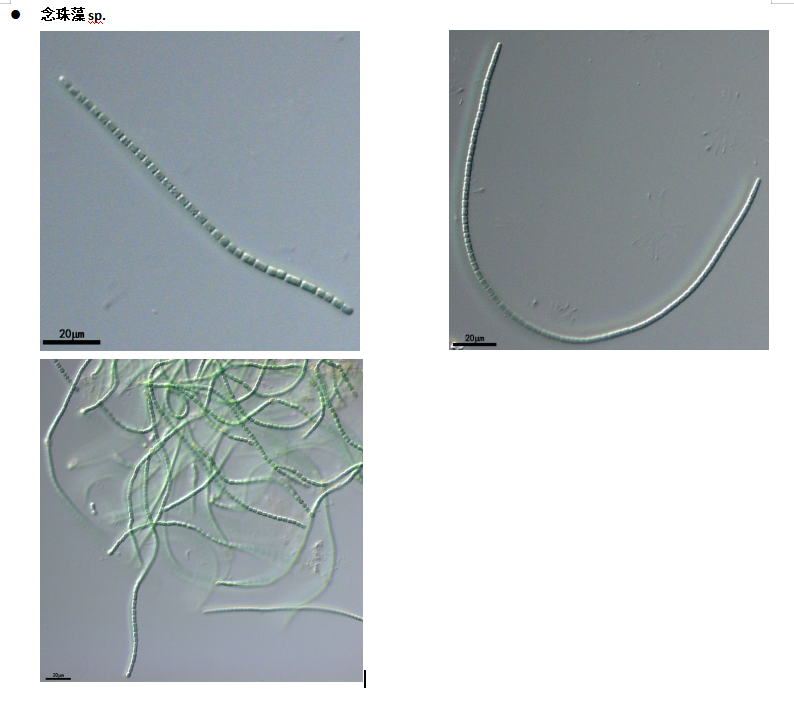
One genus of the Nostocales. The thallus is mostly spherical, or irregularly globose or sheet-like, with a very tough gelatinous envelope. Young thalli are microscopic, roughly solid spheres. As they enlarge, some remain spherical, with a smooth surface or with warts; some become hollow; some split into lobes. Hollow thalli that open into sheets have tough, torn edges. Mature thalli may reach several centimetres in diameter. Trichomes are generally flexuous; vegetative cells are similar in shape and diameter. In mature thalli the filaments and sheaths of the centre and margin differ clearly: central filaments are loosely arranged and the sheaths are almost completely dissolved into a uniform jelly, whereas marginal filaments are denser, retain a distinctly layered, brownish-yellow sheath, and the sheath is constricted in line with the constrictions between cells. Heterocysts are intercalary; hormogonia escape at the heterocysts and subsequent cell division expands the colony. Akinetes generally form on filaments of older thalli, when many or even all of the vegetative cells between two heterocysts are transformed into akinetes.
This genus differs from Anabaena in that:
① In this genus akinetes often form in large numbers between heterocysts, whereas the latter form only a few akinetes;
② Colonies of this genus are mostly firm and definite in form, whereas those of the latter are not;
③ The mucilaginous sheath of this genus is firm, whereas that of the latter readily disperses and is indistinct.
A genus of blue-green algae. Cells are arranged like a string of beads, clustered in a gelatinous mass, ranging from microscopic to walnut-sized. They occur on soil surfaces and also float in still water. Reproduction is by fission. The thick-walled spores can withstand drought for long periods; there are reports of Nostoc akinetes germinating after 70 years of dry storage when remoistened. Like most cyanobacteria, Nostoc contains blue phycocyanin and red phycoerythrin, and can fix nitrogen. In the East, one terrestrial species is used as food.
Species: the genus comprises 50 species, of which 42 have been found in China, all freshwater. Terrestrial species grow on moist soil, rocky slopes, or among the stems and leaves of mosses; some can live below the soil surface. Aquatic species generally attach to stones or aquatic plants on the bottom; truly planktonic species are fewer; they also occur on stones in mountain streams.
Product Forms
- Strain on solid medium in test tubes (can be shipped by express courier)
- Liquid strain culture (100 ml – 5 L packages)
- Large-volume algae culture (over 5 L, shipped by freight)
Product Prices
Other Algae Strain List


Reviews
There are no reviews yet.