Shanghai Guangyu Biological Technology Co., Ltd. supplies Tribonema aequale (GY-H59) algae strains and related cultivation technology, as well as 60 L–100 L photobioreactor culture equipment with temperature display, pH display, light intensity display, heating, water pump, air pump, auto-dimming LED light source. You are welcome to contact us.
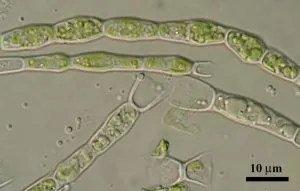
Tribonema aequale (GY-H59)
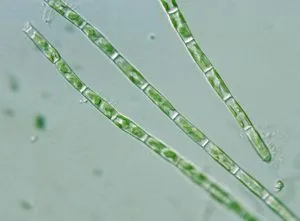
Tribonema aequale (GY-H59)
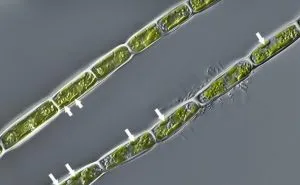
Tribonema aequale (GY-H59)
Culture medium:f/2 concentrated medium | culture medium | nutrient solution | nutrient salts
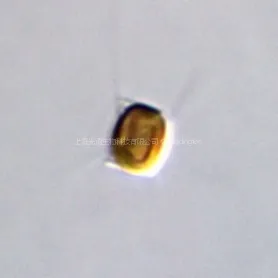
A genus of the xanthophyte family Tribonemataceae. The thallus is an unbranched filament; cells are cylindrical or slightly swollen at the sides like a drum, 2–5 times as long as wide. The cell wall is composed of two equal H-shaped pieces fitted together.
Given the excellent harvestability of filamentous Spirulina, the microalgae biotechnology group at the Qingdao Institute of Bioenergy and Bioprocess Technology proposed in 2013 a new approach of “prospecting filamentous microalgae for industrially useful oil-producing strains”. After a systematic evaluation of several dozen filamentous strains, they were the first to find that cells of the xanthophyte Tribonema (unbranched filaments) have a very high oil-producing capacity, resistance to rotifer contamination and easy harvestability. Under laboratory conditions the lipid content of Tribonema can reach 50–61%, of which 70–80% is neutral lipid. More than 95% of the cells can be recovered by direct flotation or direct filtration without flocculant, and year-round open-pond culture showed no obvious rotifer contamination (Wang et al., 2013).
- Chinese name
- Tribonema
- Latin name
- Tribonema
- Kingdom
- Kingdom Plantae
- Phylum
- Xanthophyta (yellow-green algae)
- Class
- Xanthophyceae
- Order
- Heterotrichales
- Family
- Tribonemataceae
- Genus
- Tribonema
Morphological Characteristics
The cell contains one or more parietal, disc- or band-shaped chromatophores and is uninucleate.
Distribution
The genus comprises more than 20 cosmopolitan freshwater species, of which 7 are common in China. They mostly grow in ponds and marshes, prefer calcareous habitats, also occur on moist rocks and soil, and some can survive on ice. Sexual reproduction is isogamous.
Common Species
The most common species include Tribonema minus, T. vulgare, T. ulotrichoides and others.
Product Forms
Strain on solid medium in test tubes (can be shipped by express courier)
Liquid strain culture (100 ml – 5 L packages)
Large-volume algae culture (over 5 L, shipped by freight)





Reviews
There are no reviews yet.