
Shanghai Guangyu Biotechnology Co., Ltd. custom-develops PLC process control and monitoring systems for photobioreactor and fermenter customers, including host software and I/O hardware. Please contact us at any time if you need a matching system.
(1) Basic principles for selecting the control scheme:
Powerful software and touch-screen control
- The lower-level controllers consist of, based onOPTO22 PACintelligent control nodes. It provides real-time measurement, conversion, parameter correction and basic control of temperature, pH, dissolved oxygen (DO), rotation speed, air flow, liquid level and foam level, including automatic control of parameters in sterilization and fermentation;
- based onOPTO22 PACIntelligent control nodes use original imported high-quality controllers and field-level industrial-Ethernet control technology, with a large, high-brightness LCD touch screen that is easy to operate and attractive in appearance. Control electrics are all imported name-brandsSchneider, etc.Electrical control components, precision-made and reliable in quality.
- Full Chinese operating interface with menu prompts; equipment operating status can be set as required, with a user-friendly procedure.
(3) All controlled variables of the OPTO 22 computer controller use advanced algorithms such as intelligent PID, with good stability, high accuracy and small overshoot.
3. Specific features:
(1) Control of pH, temperature, rotation speed and the like uses complete PID and split-range control, with PID auto-tuning.
(2) Eight PID auto-tuning control algorithms are available for the user to select.
(3) Dissolved oxygen can be placed in cascade control with rotation speed or air inflow, freely selectable on the host computer.
(4) Automatic-control functions, including bumpless manual/automatic switching, can be performed on both the host and the lower-level controllers, with excellent performance and high reliability. Comprehensive safety protection is provided, including buzzers and fault indicator lights for water cut-off, over-temperature, over-pressure, excess foam, high water level and overload; the fault circuit can cut off automatically, for safe and reliable operation.
Water cut-off protection: if the water supply is interrupted during operation, a water-cut-off alarm sounds, the electric heater is switched off to protect it from damage, and the inlet solenoid valve opens to add water.
Over-temperature protection: when the temperature exceeds the set point, an over-temperature alarm sounds, the electric heater automatically stops, and the cooling-water valve opens. The controller automatically calculates the required cooling ratio and controls the inflow of cooling water to prevent excessive cooling, thereby protecting temperature stability during fermentation.
Excess foam: when foam rises above the antifoam electrode, an excess-foam alarm sounds and the antifoam pump starts automatically, adding antifoam until the alarm clears and normal fermentation is restored.
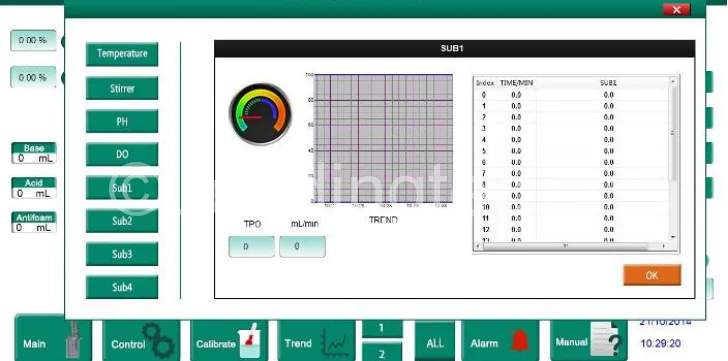
Segmented sequential feed control
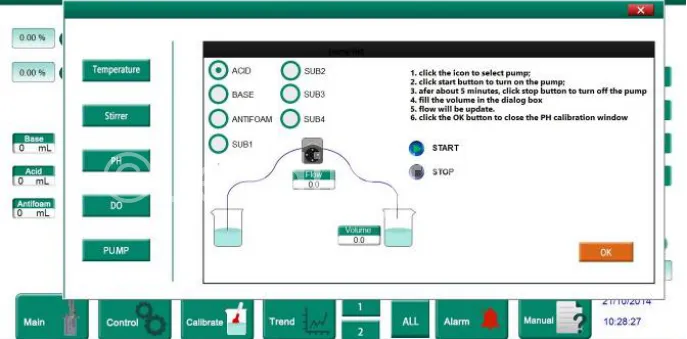
Intelligent calibration interface
(5) pH and DO measurement and conversion use highly integrated dedicated modules with high-performance isolation.
(6) The user can select low-pass, high-pass or pulse-interference-resistant digital filters on the host computer to filter real-time samples of the variables, enhancing interference rejection and measurement accuracy.
(7) Advanced split-range and predictive dual-PID control.
4. The host computer provides HMI monitoring, PID auto-tuning and Ethernet network control.
The main functions of the host computer are human–machine interface monitoring and network control. These are implemented with the host software T&J-Turbo V3.0, which is fully featured, flexible and easy to operate, with an intuitive display and intelligent functions.
Control-system functions
1. Data display and recording:
Displays and records fermentation time, temperature, pH, dissolved oxygen, rotation speed, air flow, pressure, feed volume, antifoam volume, acid/base dose and other process parameters, including real-time dynamic curves, all of which can be viewed:
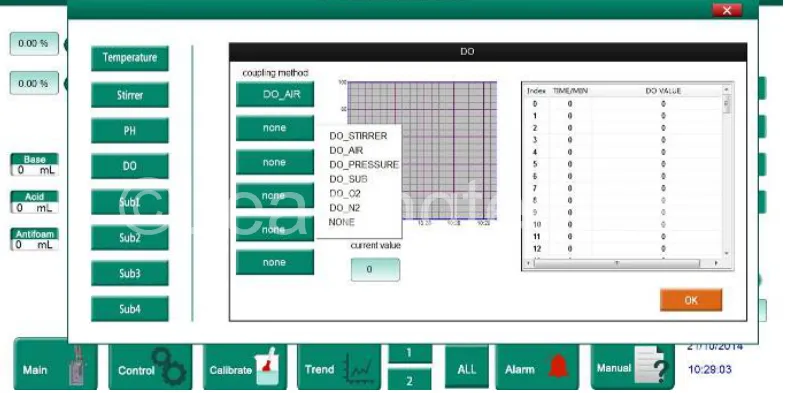
DO feedback cascade control
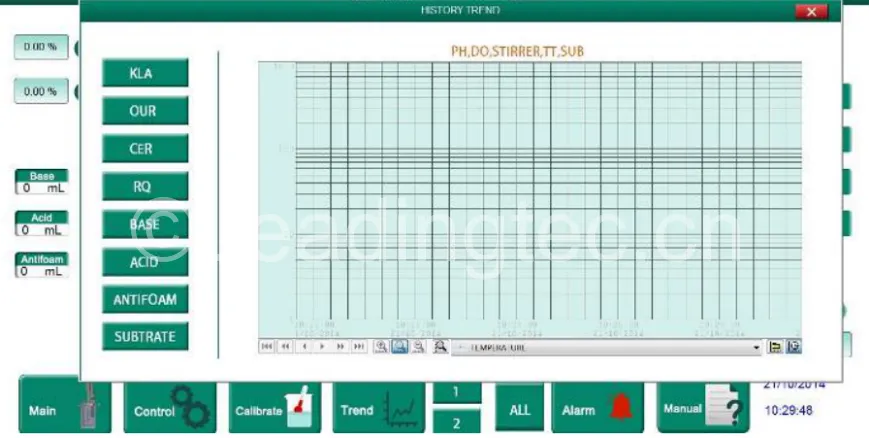
Up to 14 parameter curves
2. Control modes:
- Manual control: the valve opening ratio or valve position can be set.
- Automatic control: PID continuous or PID on/off control can be selected.
- Sequential control: up to 20 control segments can be preset for all control parameters, for automatic staged control.
- Cascade control: dissolved oxygen can be controlled via rotation speed, air flow, vessel pressure, feed, etc.
3. Metering: feed, antifoam, acid and base can be metered.
4. Curve functions: real-time dynamic curves can be displayed and analysed, historical data curves recorded, and printed directly.
5. Calibration: software correction of pH, DO, peristaltic-pump flow rate and other parameters, quick and convenient.
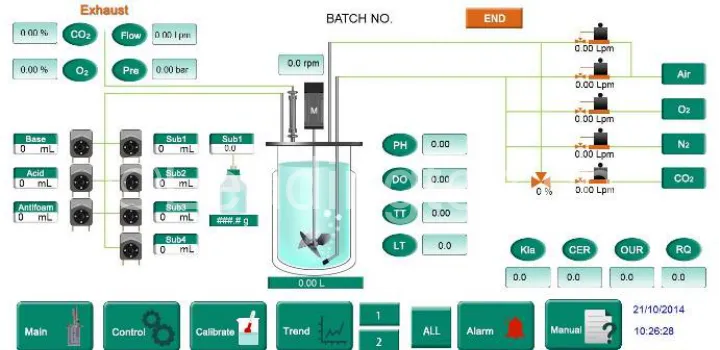
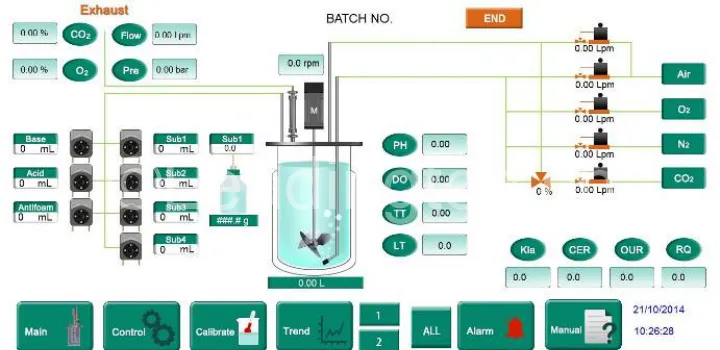
6. Process flow diagram: a schematic flow sheet displays dynamic real-time data for each measuring point on the same screen, clearly and intuitively.
7. Process-information query: complete records of each fermentation batch and a brief description can be queried at any time, including historical fermentation data and process summaries.
8. Data processing: recorded data can be exported directly asEXCELformat, and users can produce data reports and curves to their own conventions.
9. Curve printing: historical curves can be printed directly, and a print template can be selected to set the format.
10. One-key restore: system data such as PID parameters can be changed as needed. If changes do not give the expected result, if the environment changes and parameters must be corrected, or if a critical parameter is changed in error and the software cannot run normally, a factory-reset button restores all default system parameters in one step.
control system Features
1. Host monitoring is implemented in software developed on the well-known US platform LabWindows/CVI. The first item on the host display is the system main menu, with ten options; the operator clicks any one of them to enter the required submenu. The ten main-menu options are
- Process display Process (Display Process)
- Instrument calibration (Calibration)
- Control loop Control (Control loop Display and Set)
- Variable display Display (Display)
- Dynamic trend Trend (X-Y Trend Graphs)
- Alarm display Alarms (Alarms)
- Cascade control (Cascade Control)
- Automatic sterilization (Automation Sterilization)
- Control-loop configuration (Configuration)
- PID auto-tuning Auto Tuning (PID Auto Tuning)
2. The supervisory industrial control computer displays equipment models and operating status in schematic form, issues control commands, and handles alarming, archiving and printing. By analysing and calculating historical and current process parameters and fermentation performance, process conditions can be optimized and parameters set and sent back to the lower-level controllers; alarm high/low limits can be set and alarm status displayed; networked computer management is also supported.
3. Network communications use an industrial Ethernet interface and standard protocols, so that one host computer can remotely control multiple lower-level controllers over a site LAN or the Internet. Networking is flexible and convenient, without dropped connections, lost data or burned main boards. Reliability and stability are much higher than with ordinary RS-485 or RS-232 interfaces.
4. The host software successfully solves synchronization between the host and lower-level controllers, ensuring consistency during fermentation. Because both can operate the fermenter, control commands must be consistent; in this system, control priority is assigned in time, ensuring consistency and stability.
5. The host software has an attractive display, complete functions, flexible and simple operation, an intuitive screen and intelligent expansion; its performance and stability exceed those of typical domestic counterparts.


Reviews
There are no reviews yet.