
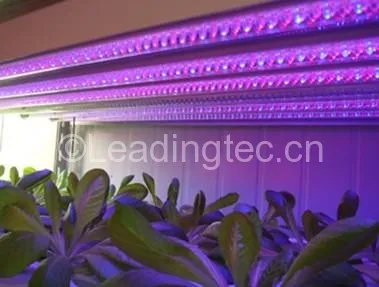
As modern agriculture develops, demand for agricultural lighting and its energy use continue to grow. As a new-generation light source, LEDs are not only environmentally friendly and energy-saving, but compared with fluorescent lamps, high-pressure sodium lamps and other artificial sources commonly used in agriculture, they offer adjustable light quantity and quality and a rich range of wavelengths. LED applications can be expected to bring a new “revolution” to agriculture.


In 2013 Shanghai Guangyu Biotechnology Co., Ltd. moved from civil lighting into the development and production of LED agricultural lighting. Together with industry experts, it has carried out experiments with agricultural bases, greenhouse growers, plant factories and laboratories, focusing on the effects of individual LED wavelengths onAlgal culture, and the different effects at different stages of seedling tissue culture, vegetable growing and valuable ornamental plants.
Product types developed
- High-power LED algal grow light
- LED greenhouse supplementary lighting
- LED plant grow light
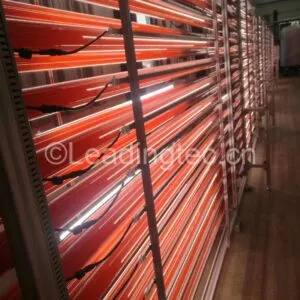
- LED supplementary lighting for indoor growing
- LED algal tissue-culture light

The colour temperature and brightness of a grow light are what the human eye sees, whereas the spectrum plants need for growth differs from what the eye sees. Plant photosynthesis is not determined by the lamp’s colour temperature or brightness.
The wavelengths emitted by LEDs of different colours are given in the table below:
- royal blue: 445 nm (440–460 nm)
- blue: 470 nm (460–490 nm)
- cyan: 505 nm (490–520 nm)
- green: 530 nm (520–550 nm)
- red: 627 nm (620–645 nm)
- red-orange: 617 nm (613–620 nm)
- amber: 590 nm (585–597 nm)
The microalgae growth lamp is used mainly for hydroponic culture, horticulture and greenhouse lighting, sowing/seedlings/propagation, farms, flower shows, gardens, potted plants and the like. It is ideal for all stages of plant growth and is suitable for indoor gardens and for plants in hydroponic or soil culture.
Notes:
- The beam angle of a single LED is 120°, so no diffuser plate is needed.
- In the current product range, T8, T5 and 14 W low-power LED lamps can be made with all-blue LEDs; high-power blue LED lamps can only be made with a 1:1 mix of blue and white LEDs, not with all-blue LEDs.


Reviews
There are no reviews yet.