
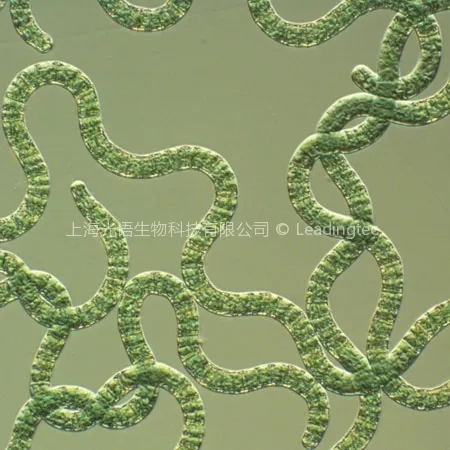
Shanghai Guangyu Biological Technology Co., Ltd. supplies Spirulina sp. (GY-D18) algae strains, culture media and related cultivation technology, as well as 1 L–5000 L photobioreactor culture equipment with temperature display, pH display, light intensity display, heating, water pump, air pump, auto-dimming LED light source and other algae culture accessories. You are welcome to contact us.
Culture medium:Zarrouk’s medium (Z medium)
Guangyu Biotech also suppliesculture-media nutrients for large-scale microalgae production.
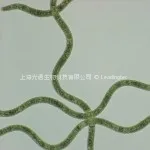
Classification
|__Kingdom: Protista
|__Phylum: Cyanobacteria (blue-green algae)
|__Class: Cyanophyceae
|__Order Oscillatoriales (hormogonalean)
|__Family: Oscillatoriaceae
|__Genus: Spirulina
Research Applications
Distribution: Lake Chad in Africa, Lake Texcoco in Mexico, Chenghai Lake in Lijiang, Yunnan, China, and others.
Morphology: Helical filaments. Cyanobacterial cells have no chromatophores; pigments are distributed in the outer pigmented region of the protoplast and are blue-green. Inside the protoplast is a colourless central region resembling the nucleus of other algae, but without a nucleolus or nuclear membrane, so Spirulina is a prokaryote. Spirulina platensis is filamentous, with helical, blue-green trichomes without cross-walls; filaments are 4–5 μm wide and 400–600 μm long. The apical cell is bluntly rounded, and there are no heterocysts.
Reproduction
Spirulina has two types of reproduction:
I. Vegetative reproduction, including direct cell division (fission), fragmentation of colonies, and the production of hormogonia by filaments.
II. Some Spirulina species can produce endospores or exospores for asexual reproduction. The spores have no flagella. True sexual reproduction has not yet been found in Spirulina [3].
Ecological conditions
1. Salinity: Spirulina platensis originally grows in alkaline water and can be acclimated to ordinary seawater.
2. Temperature: the optimum range is 30–37 °C.
3. Light: the optimum light intensity is about 30,000–35,000 lx.
4. pH: the optimum range is about pH 8.6–9.5.
Chemical composition
It contains about 60% protein, composed mainly of isoleucine, leucine, lysine, methionine, phenylalanine, threonine, tryptophan, valine and other amino acids. It also contains fat, carbohydrate, chlorophyll, carotenoids, phycocyanin, vitamins A, B1, B2, B6, B12 and E, nicotinic acid, creatine, γ-linolenic acid, calcium pantothenate, folic acid, and calcium, iron, zinc, magnesium and other minerals.
Product Forms
- Strain on solid medium in test tubes (can be shipped by express courier)
- Liquid strain culture (100 ml – 5 L packages)
- Large-volume algae culture (over 5 L, shipped by freight)


Reviews
There are no reviews yet.